

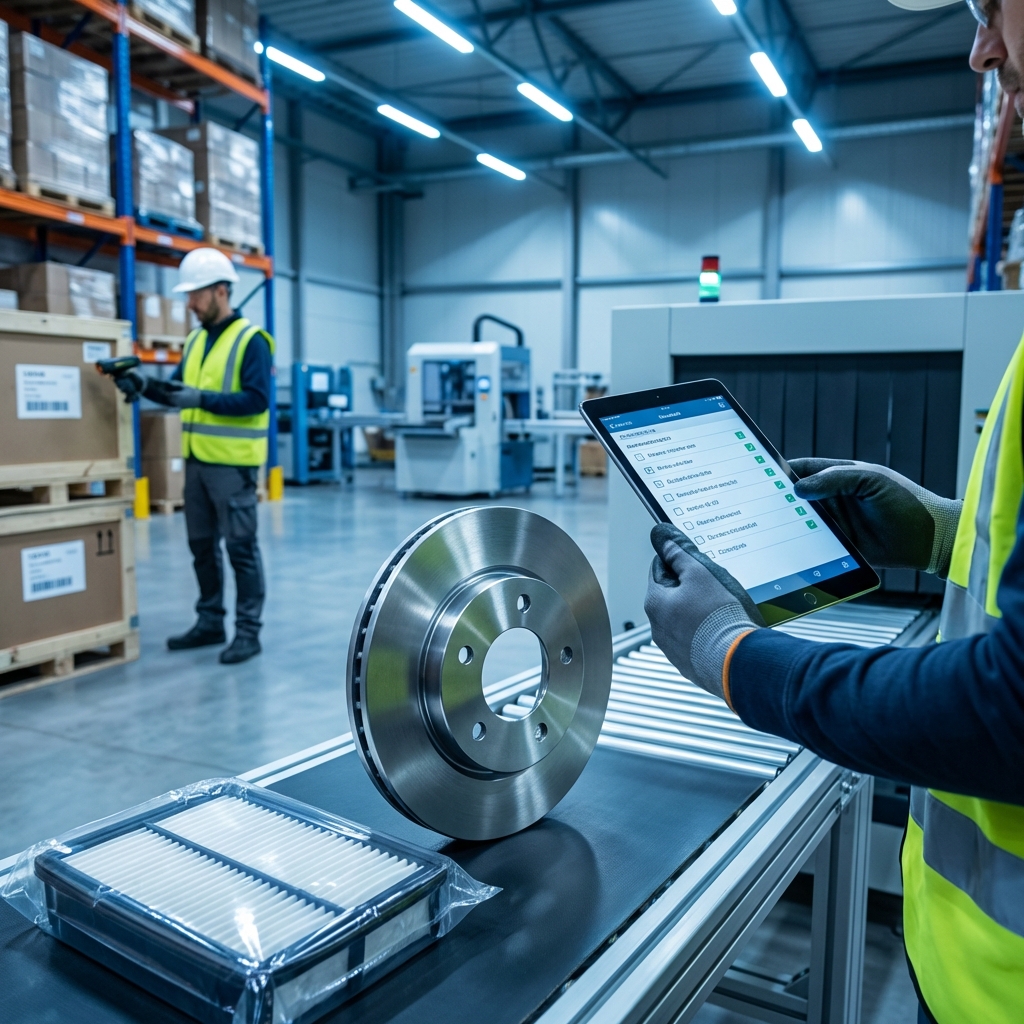
Import Auto Parts Morocco: 2026 Guide
The auto parts market in Morocco has entered an era of absolute rigor in 2026. Discover the VOC program requirements, NM standards specifics, and the Salamatouna label.
Equipe Casa Horizon
Transitaire agréé
Sommaire
The Quality Shift of 2026
Faced with road safety challenges and the rise of local industry, authorities have locked down import processes. The era of 'adaptable' parts without traceability is over: today, every brake pad or shock absorber entering the territory must prove its worth via an arsenal of digital certifications.
Whether you are an established distributor or an entrepreneur starting in imports, this guide dissects the VOC program requirements, the specifics of NM standards, and the now central role of the Salamatouna label.
🛡️ The VOC Program: Certificate of Conformity (CoC) First
Since the verification of conformity (VOC) program reform, spare parts checks are no longer random at Casablanca port. It is mandatory and anticipated.
Before goods leave the export country (China, Turkey, Europe), the importer must obtain a Certificate of Conformity (CoC). This document is issued by approved inspection bodies (Applus+, Bureau Veritas, SGS, TUV) after physical and documentary checks at the supplier.
Critical Point 2026
🏗️ NM Standards: The Red List of Safety Parts
The Ministry of Industry has established a list of Moroccan Standards (NM) for mandatory application. These standards mainly concern 'critical' components. Importing a part that does not respect these standards exposes the importer to immediate seizure and destruction of goods.
Monitored Product Families
Braking System
Suspension & Steering
Lighting & Visibility
Filtration
🏷️ Salamatouna Label: The IMANOR Trust Passport
To clean up the market, Morocco generalized the Salamatouna label (managed by IMANOR). In 2026, it is the holy grail for importers. It is a certification mark testifying that the company controls its supply chain and only markets authentic and compliant parts.
Labeling Process
IMANOR Audit
Storage Control
Digital Platform
Casa Horizon Advantage
💰 Customs Clearance 2026: Tax Calculation
The 2026 Finance Act maintained high duties on finished products to encourage the local industrial ecosystem.
Calculation Formula (D&T)
ID (Import Duty): 17.5% to 40% (0% if EU/Turkey origin with EUR.1).
VAT: 20% on spare parts.
TPI: 0.25%.
Morocco Customs Duty Simulator
Estimate the real landed cost of your import (DDP)
1Import Data
Standard rate (Furniture, Auto parts...).
2Simulation Results
Enter the value of your goods to see the tax breakdown.
🚫 Total Ban on Used Parts
📦 Logistics: Storage Obligation (Art. 19 bis)
The 2026 Finance Act strengthened Article 19 bis. Now, every importer must accurately declare the actual storage location of goods after customs clearance. This measure aims to eliminate 'suitcase importers'.
- Penalty: 30,000 to 60,000 MAD fine for false declaration.
- Solution: Use approved MEAD (Customs Clearance Areas) to ensure a smooth transition.
✅ Quick Takeaways: What to remember
Mandatory CoC
0% Customs
Zero Used Parts
Salamatouna Label
💡 Conclusion
Importing spare parts to Morocco in 2026 is a precision trade. The convergence between IMANOR requirements and ADII surveillance creates a powerful filter that only lets quality through.
By relying on Casa Horizon expertise, you not only secure your margins but also actively participate in road safety in the Kingdom.
Frequently Asked Questions
How to get the Salamatouna label?
Is the EUR.1 certificate enough to prove conformity?
Are accessories subject to CoC?
Can I import batteries?
What is the average customs clearance time?
Sources & Références
Read also

Importing Cosmetics and Parapharmacy to Morocco: Complete AMMPS/DMP Registration Guide 2026
2026 marks a historic turning point with the transition to AMMPS and mandatory Halal certification. Complete guide to registering your cosmetic products.

Import Medical Equipment Morocco: DMP Guide 2026
Healthcare sector in Morocco is transforming in 2026. Complete guide on AMMPS registration, device classification, and customs procedures.
Import Furniture & Decor to Morocco: 2026 Guide
Between Asian freight costs, Turkish tariff barriers, and European prestige, choosing the right source is a challenge. This comparative guide analyzes the three giants: China, Turkey, and Italy.
Let's Optimize Your Supply Chain
Discuss your logistics challenges with a trade expert.