

Importing Used Clothing to Morocco: Is it Authorized? (Legal Guide 2026)
Circular economy and second-hand fashion are booming. But can you legally import used clothes (friperie) to Morocco in 2026? A complete guide on legal framework, licenses, and customs realities.
Equipe Casa Horizon
Transitaire agréé
Sommaire
The Paradox of Friperie in Morocco in 2026
In 2026, the contrast is striking: while "luxury vintage" shops flourish in Casablanca and Rabat, the customs gateway remains officially locked for most. Morocco is at a crossroads between growing demand for sustainable fashion and the need to protect its local textile industry, which employs hundreds of thousands.
Importing used clothing is not a standard commercial operation like importing smartphones or furniture. It is a derogatory regime subject to constant state surveillance.
⚖️ The Legal Framework: What the Law Says
Morocco's official position in 2026 remains unchanged. This measure is governed by foreign trade law and Customs Administration (ADII) circulars.
Why does Morocco protect its textile industry?
The textile-clothing sector is a pillar of "Made in Morocco". Allowing massive imports of cheap bales from Europe or the USA would destroy local factory competitiveness. In 2026, the government favors local integration. Friperie is seen as unfair competition as it doesn't bear the same production costs.
🆘 The Exceptions: Who can import?
There are two legal channels (though very restricted) to bring used clothes into Morocco in 2026:
- Public Utility Associations: Some NGOs and foundations can receive clothing donations from abroad. This requires special authorization. Clothes must be distributed for free and cannot be resold.
- Sorting Companies in Free Zones: A few licenses have been granted to companies in industrial acceleration zones (like Tanger Med). They import bales, sort, and recondition, but must export 100%. Selling on the local market is strictly prohibited.
📝 The Import License: The Golden Key
For rare cases where import is considered, it requires an import license from the Ministry of Industry. In 2026, obtaining this for a new private operator is nearly impossible.
The application requires:
- Justification of social or economic utility.
- Commitment not to sell on the domestic market.
- Disinfection certificate certified by origin health authorities.
🦠 Sanitary Standards & Certificates
If you get authorization, the sanitary barrier is next. Used clothes can carry parasites. In 2026, ONSSA requires an original Fumigation Certificate. Every bale must be treated with approved products.
🧮 Tax Calculation (If authorized)
If authorized, taxes are calculated on net weight or estimated transactional value.
Taxes = (Weight × Ref_Value × Duty) + VAT(20%) + TIC
Duty: Often fixed at max rate of 40% to discourage entry.
🚫 Risks of Informal Import
Many traders try to pass used clothes as "Personal Effects" or "New Clothes". In 2026, customs scanners use AI to detect the specific density of compressed bales.
- Immediate confiscation of goods.
- Fines up to 5 times the goods value.
- Criminal prosecution for smuggling.
👗 Alternatives for Entrepreneurs
How do luxury second-hand shops survive?
- Luxury Vintage: Often local sourcing or specific collection items (not bales).
- Deadstock (Outlet): Importing unsold new clothes with tags. They pay full duty (40%) but are 100% legal.
- Upcycling: Importing used fabrics to transform them in Morocco is a more accepted path (ATPA Regime).
📦 Logistics: Transporting Used Textiles
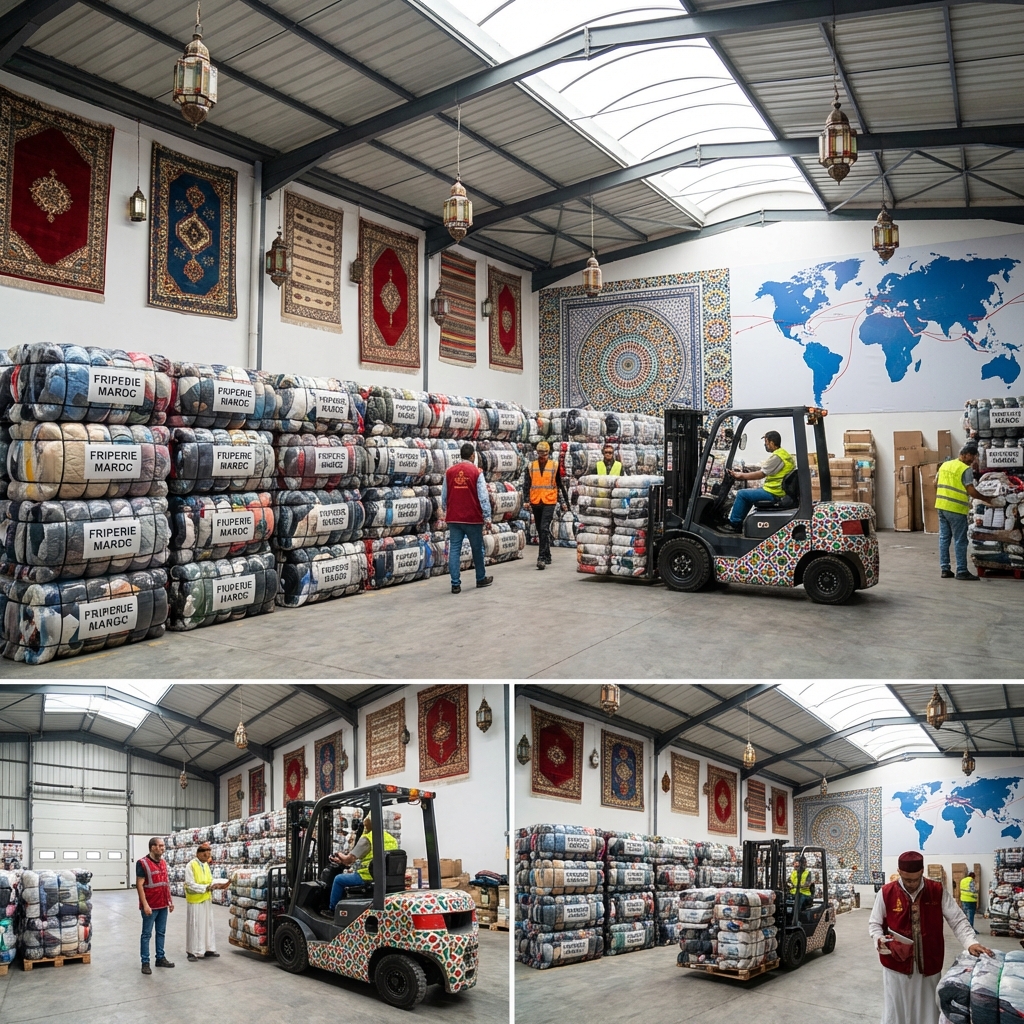
Transport uses hydraulic presses to create bales of 45kg, 80kg or 400kg.
Volume
A 40' HC container can hold up to 25 tons of compressed clothes.
Protection
Humidity is enemy #1. Bales must be wrapped in reinforced plastic film.
✅ Quick Takeaways
- Status: Commercial import strictly prohibited for local market.
- Exception: Only for associations (donations) or free zones (re-export).
- Sanitary: Disinfection certificate mandatory.
- Taxes: 40% import duty if derogation obtained.
- Alternative: Prefer new deadstock or Upcycling.
Conclusion
Importing friperie to Morocco in 2026 is legally nearly impossible for standard entrepreneurs. Consult Casa Horizon before starting any project.
Questions Fréquemment Posées
Can I import used clothes in my luggage as a MRE?
What about used shoes?
Is there an import quota?
Is outlet considered friperie?
Why is friperie in souks if prohibited?
Sources & Références
Read also
Supplier Audit in China and Turkey: The Anti-Scam Guide 2026
Secure your imports with a professional factory audit. Verify the legality, capacity, and quality of your suppliers in China and Turkey before paying.
Importing Packaging Materials to Morocco: Complete Guide and Ecological Taxes 2026
Expert guide for importing packaging to Morocco: Law 77-15, Ecological Tax, NM standards, and Article 19 bis. Secure your costs and compliance in 2026.
Import Fitness Equipment Morocco: 2026 Guide
Complete guide to importing fitness equipment to Morocco: C-Mark, NM Standards, Customs Clearance, and Logistics. Equip your gym with full compliance.
Let's Optimize Your Supply Chain
Discuss your logistics challenges with a trade expert.